
Call for a consultation(270) 483-3001
Protecting Your Family Member’s Future Without Losing Their Benefits
You want to leave money, a settlement check, or a gift to a family member with a disability, and you need to know it will not cost them the Supplemental Security Income (SSI) or Medicaid they depend on every month. An inheritance handled the wrong way, even with the best intentions, can end Social Security and Medicaid support.
As a Hopkinsville special needs planning lawyer, Collins Law pairs legal drafting with an in-house social worker who has spent more than 30 years coordinating care and benefits for families.
Contact Collins Law to walk through the property, settlement, or gift you are trying to protect, and we will help you identify the kind of trust designed to help protect your family member’s benefits.
| Practicing Law Since 1994 | Licensed in Kentucky & Tennessee | Avvo 5.0/5.0 Rating – Client Review | Past President, Kentucky Chapter, National Academy of Elder Law Attorneys |
Service that makes a difference.
Every family’s situation looks a little different. The right tool depends on where the money is coming from and what your loved one already receives. We may consider:
If money reaches your family member directly, even by accident, Kentucky’s SSI and Medicaid programs can count it against the resource limit the same month it arrives. That can mean a full month, or several, with no health coverage and no check, while the family scrambles to spend the extra money down or return it.
A first-party trust has to be approved by the court before that money is protected. Under KRS 387.865, only certain people have standing to ask the court to approve one. This includes the special needs person, a sibling, a guardian or conservator, someone holding power of attorney for them, or, in most cases, a parent or grandparent funding the trust.
If you miss that step, or draft the trust with the wrong language, Medicaid can still count the assets against your family member’s eligibility even after the paperwork is filed.
Petitions for a first-party special needs trust are filed with the District Court at the Christian County Justice Center, 100 Justice Way in Hopkinsville, the same courthouse that handles guardianship and probate matters for the county. We prepare the petition, gather the required documentation, and represent your family at every step the court requires before it will approve the trust.
Collins Law’s Social Work Consultant, Jill Collins BSW, LSW, has spent more than 30 years coordinating geriatric and disability care and benefits across Kentucky. She works alongside the attorney handling your case so the trust actually matches how your family member lives day to day, not just what looks right on paper. That combination, a licensed attorney and a licensed social worker reviewing the same plan, is not something every firm serving the Pennyrile region can offer.
We hear from parents planning ahead for a child who will need support as an adult, from adult children managing a settlement or inheritance for a sibling with a disability, and from grandparents who want to leave something behind without accidentally cutting off SSI or Medicaid.
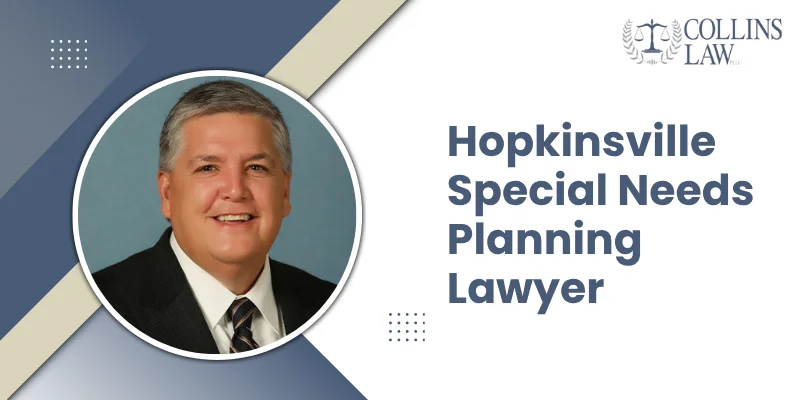
Attorney Mark D. Collins has been licensed in Kentucky since 1994 and in Tennessee since 2020. The firm regularly serves families across Christian, Todd, and the surrounding Pennyrile counties, along with the Clarksville, Tennessee area, so a family split across the state line does not need two separate lawyers to get one plan right.
The District Court reviews the petition, may appoint someone to look out for your family member’s interests during the case, and holds a hearing before approving the trust.
A first-party trust holds money that already belongs to your family member, such as a settlement, and requires court approval and a Medicaid payback provision. A third-party trust holds money from someone else, like a parent, and carries no payback requirement.
We can still help. A first-party trust can hold those funds going forward, but it still requires a petition under KRS 387.865 and court approval before the money is protected from being counted against benefit eligibility.
Cost depends on whether you need a first-party trust that requires court approval or a third-party trust that does not. We give you a clear, written estimate before any work begins.
A properly drafted trust can pay for a wide range of supplemental needs, from therapy and transportation to a caregiver or home modifications, as long as the trustee avoids paying for things Medicaid or SSI already covers directly, since that can reduce the monthly benefit instead of protecting it.
Bring whatever you have. A copy of a will naming your family member as a beneficiary, a settlement agreement, recent SSI or Medicaid award letters, and a rough list of the accounts or property involved all help us map out the right plan faster.
If your situation does not fit neatly into one of these answers, that is normal, and it is exactly what a consultation is for.
You don’t have to map this out on your own. Contact Collins Law to schedule a confidential consultation, and bring whatever paperwork you already have, so we can discuss the legal options available to meet your family’s needs.
Fields Marked With An “*” Are Required
*Images are obtained under license from Canva and other third-party stock image providers,
with attribution included where required.
© 2026 Collins Law, PLLC• All Rights Reserved. Disclaimer | Site Map | Privacy Policy. Digital Marketing By: 


